The Epidemic Unit
High School Biology | 7 Lessons (~8hrs)
Unit Overview
Students will work together to recommend a mitigation strategy for a fictional town facing an epidemic. They will do this by using a computer-based simulation to design multiple experiments, collect data, engage in peer review, and construct and critique conclusions with the goal of seeking consensus. Students will grasp the methodological and social practices that scientists use to generate reliable knowledge. This unit can serve as a replacement or supplement to a Nature of Science unit.
On this page:
Unit Map
Expected Prior Knowledge
[Explanation of the Unit map here - Below you will find a quick guide to each lesson in the Epidemic Unit. To find more resources and detailed plans for each lesson, click on the Lesson Title.]
LESSON 1 | Why Model
Essential Question: How do scientific models help us to understand, explain, visualize, and predict natural phenomena?
Main Goal: Students will expand their understanding of what a scientific model is by engaging in a model-building activity marked by peer feedback and shared criteria for good modeling (e.g., revising models with new evidence).
Approximate Time: ~60 minutes
LESSON 2 | Reliable Strategies
Essential Question: What criteria makes scientific information reliable and trustworthy?
Main Goal: Students will engage in scientific argumentation as they work together to evaluate the quality of evidence and develop criteria for good scientific practices.
Approximate Time: ~60 minutes
LESSON 3 | The Epidemic Simulation
Essential Question: How can we design an experiment that would produce valid data and reliable results?
Main Goal: Students will reflect on prior experiences with infectious diseases (e.g., COVID-19). Students will be introduced to the town’s problem, explore the simulation, and apply their class criteria for good scientific practices (from Lesson 2) to analyze experimental designs.
Approximate Time: ~60 minutes
LESSON 4 | Planning an Experiment
Essential Question: How does constructive feedback improve the reliability of experimental design?
Main Goal: Students will use the simulation and criteria for good scientific practices to design an experiment to explore the effectiveness of their mitigation factor (e.g., hand-washing) for the town. Students will critique their peers’ methodologies and utilize feedback to improve their designs.
Approximate Time: ~120 minutes
LESSON 5 | Resolving Disagreements
Essential Question: Why do scientists disagree with each other and how do they resolve disagreements?
Main Goal: Students will understand some of the reasons why scientists disagree and aim to seek consensus. Students will analyze scientific disagreements and work to come to consensus with their peers before applying this practice in Lesson 6 with class data.
Approximate Time: ~60 minutes
LESSON 6 | Making Sense of Data
Essential Question: Why do scientists seek consensus, collaborate, communicate, critique each other, and share evidence?
Main Goal: With their peers, students will synthesize findings from multiple experiments to come to consensus on a single mitigation recommendation for the town based in all the high-quality evidence. Students will understand the social nature of scientific practice (i.e., peer review and seeking consensus)
Approximate Time: ~60 minutes
LESSON 7 | Connecting to the Public Sphere
Essential Question: How do scientists responsibly communicate complex socioscientific issues to the public?
Main Goal: Students will evaluate the quality of evidence using their criteria for good scientific practices. Students will understand how the practices they used in this unit reflect those used by scientists to address real-world socio-scientific issues.
Approximate Time: ~60 minutes
Crunched for Time?
Overview: This version condenses the unit into 3 lessons that can be implemented over X days.
Looking for Additional Ideas?
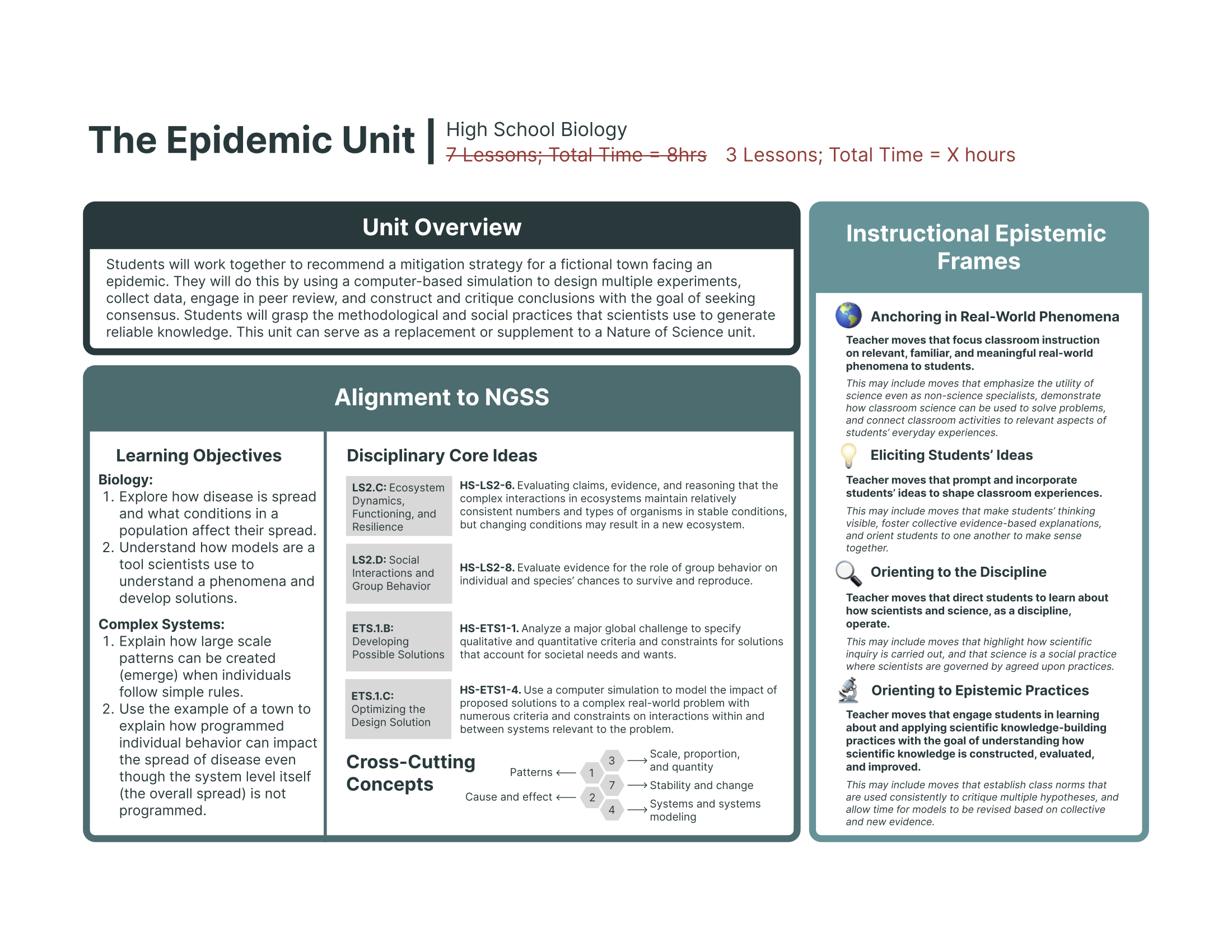
Below are three modified versions of the Epidemic Unit adapted by teachers and used in their classrooms.
The documents are designed to track the changes made by teachers, so you will notice a lot of red text and strikethroughs that show the teachers’ exact additions and removals from the original unit!
Additional teaching resources are also linked in the documents.
Lauren’s Version
Overview: This version focuses on…
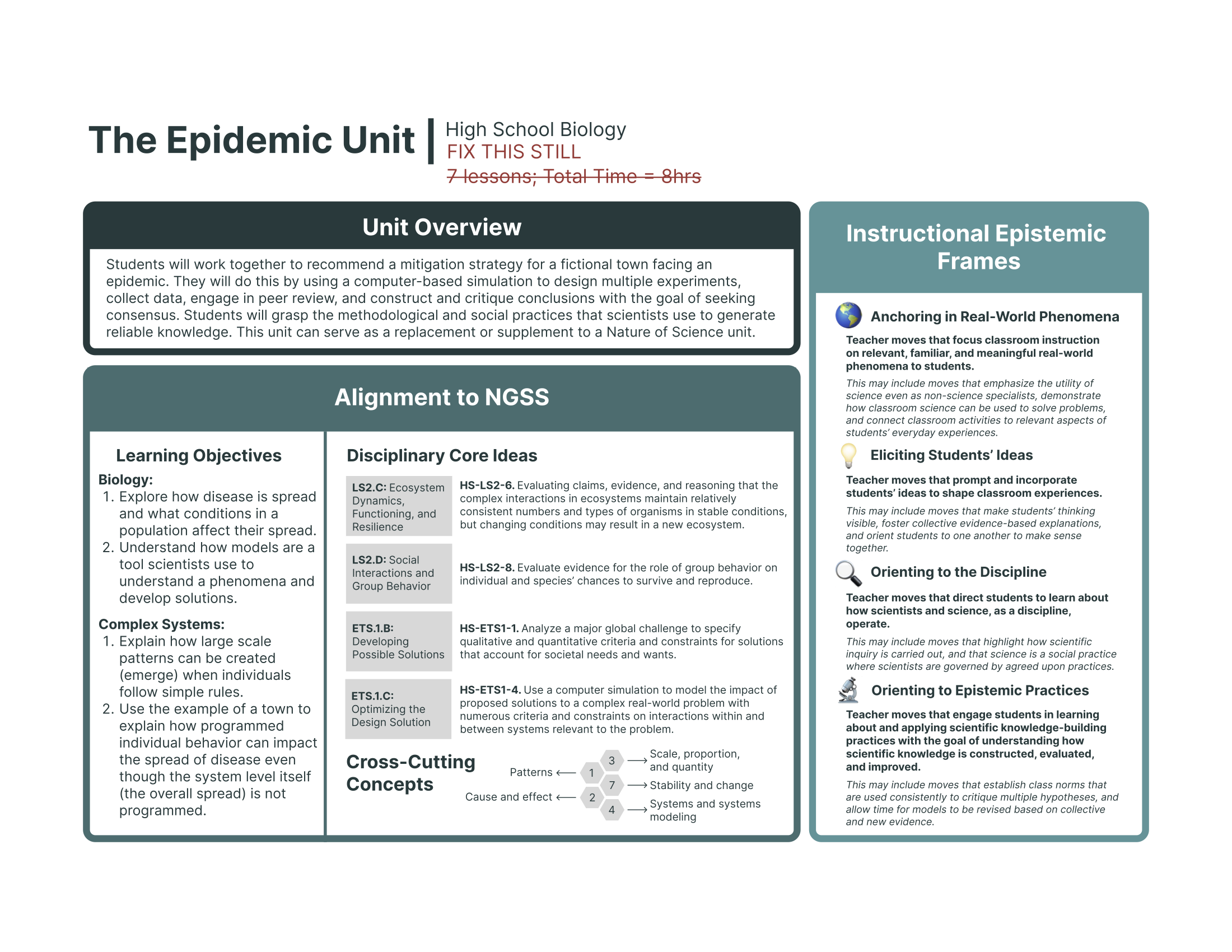
Chemistry-Spin
Overview: This version was adapted by a high school Chemistry teacher and serves as an introduction to the Nature of Science with a focus on modeling.
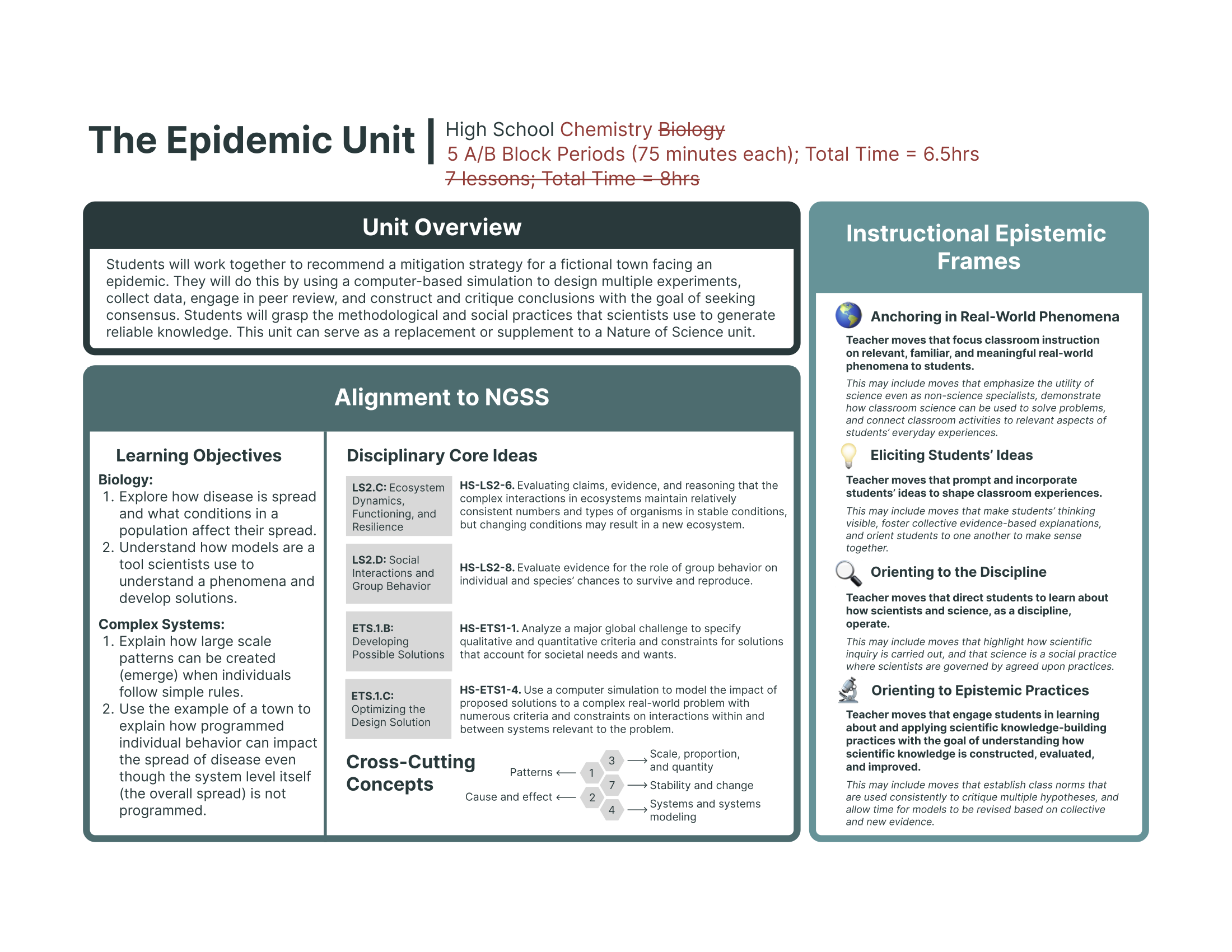
Alignment to NGSS
Lesson Objectives
| Biology | Complex Systems |
|---|---|
| Explore how disease is spread and what conditions in a population affect their spread. | Explain how large scale patterns can be created (emerge) when individuals follow simple rules. |
| Understand how models are a tool scientists use to understand a phenomena and develop solutions. | Use the example of a town to explain how progammed individual behavior can impact the spread of disease even though the system level itself (the overall spread) is not programmed. |
LS2.C: Ecosystem Dynamics, Functioning, and Resilience
HS-LS2-6. Evaluating claims, evidence, and reasoning that the complex interactions in ecosystems maintain relatively consistent numbers and types of organisms in stable conditions, but changing conditions may result in a new ecosystem.
Disciplinary Core Ideas
LS2.D: Social Interactions and Group Behavior
HS-LS2-8. Evaluate evidence for the role of group behavior on individual and species’ chances to survive and reproduce.
ETS.1.B: Developing Possible Solutions
HS-ETS1-1. Analyze a major global challenge to specify qualitative and quantitative criteria and constraints for solutions that account for societal needs and wants.
ETS.1.C: Optimizing the Design Solution
HS-LS2-6. Evaluating claims, evidence, and reasoning that the complex interactions in ecosystems maintain relatively consistent numbers and types of organisms in stable conditions, but changing conditions may result in a new ecosystem.
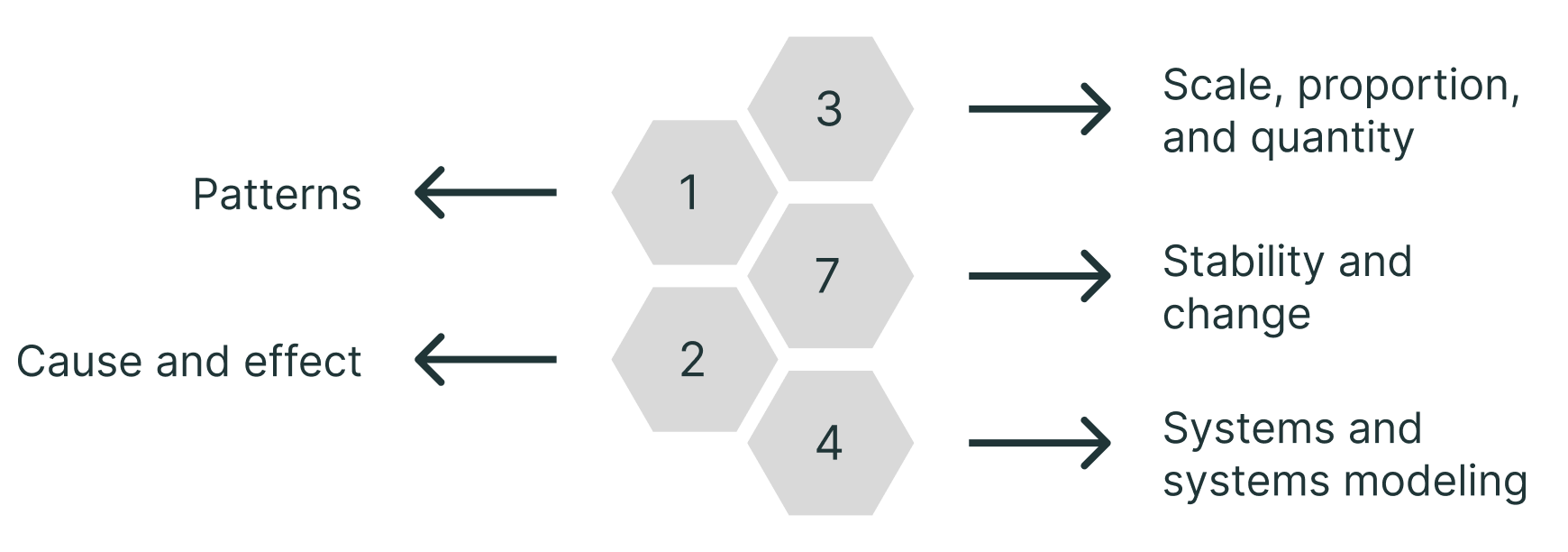
Cross-Cutting Concepts
Instructional Epistemic Frames
[Explanation of IEFs here - Instructional Epistemic Frames (IEFs) are teacher moves intended to support students’ authentic engagement with and understanding of scientific practices.
Throughout the lesson plan, you will see these icons that depict the four different IEFs, described below.]
-
Teacher moves that focus classroom instruction on relevant, familiar, and meaningful real-world phenomena to students.
This may include moves that emphasize the utility of science even as non-science specialists, demonstrate how classroom science can be used to solve problems, and connect classroom activities to relevant aspects of students’ everyday experiences. -
Teacher moves that prompt and incorporate students’ ideas to shape classroom experiences.
This may include moves that make students’ thinking visible, foster collective evidence-based explanations, and orient students to one another to make sense together. -
Teacher moves that direct students to learn about how scientists and science, as a discipline, operate.
This may include moves that highlight how scientific inquiry is carried out, and that science is a social practice where scientists are governed by agreed upon practices. -
Teacher moves that engage students in learning about and applying scientific knowledge-building practices with the goal of understanding how scientific knowledge is constructed, evaluated, and improved.
This may include moves that establish class norms that are used consistently to critique multiple hypotheses, and allow time for models to be revised based on collective and new evidence.